Discarded toys show up in strange places. I’ve found many down by
the railroad tracks on Ohio Street. Were these toys part of a Happy Meal
collection thrown out by a young ‘traveler’? Close to the discarded toy site
was the massive Concrete Central grain elevator. Inside the elevator was a
paint ball team happy to pose as urban warriors. The toy, the team and the graffiti all came
together in this “neighborhood in a box.”
You can see it and others in my
space at the ECHO Art Fair this September 6 – 7, at the Central Library,
downtown at One Lafayette Place in Buffalo.
Friday, August 22, 2014
Monday, August 4, 2014
LITTLE BLACK BOOTS
Coming up August 9th is the Buffalo Society of
Artists Open Members Show. This year’s exhibit is at the Theodore Roosevelt
Inaugural National Historic Site on Delaware Avenue. In honor of ‘Teddy,’ I’m
showing ‘Little Black Boots’. This
assemblage combines a discarded baby photo, acrylic paint, and my photos of
abandoned houses. It’s framed with recycled wood.
This photo reminds me of my grandfather who believed that all
children should wear little black boots. Perhaps because the terrain was so
rough 150 years ago? Perhaps they produced strong ankles? Who knows? Anyway,
Theodore Roosevelt wore them too! Here’s a picture of TR as a boy plus another
vintage picture of children of that era.
The Theodore Roosevelt Inaugural National Historic
Site is at 641 Delaware Avenue, Buffalo, NY. There will be an Opening Reception
on Saturday, August 9, 2014, from 3 until 5 PM. The exhibit will be on view
until Monday, September 8. The TR
Gallery is open Monday through Friday from 9 AM to 5 PM. On Saturday and
Sunday, it will be open from Noon until 5 PM.
Tuesday, July 15, 2014
STILL WAITING FOR THE WRECKING BALL
1681 Fillmore Avenue has been waiting for years. It’s been on the
official top ten list to be demolished since at least May, 2012. Meanwhile,
it’s wide open and dangerous, filled with tires, toys, wooden pallets and
broken furniture. Filthy vinyl hangs from the ceiling like depressed flags.
Evidence of gang activity shows in the graffiti throughout. This place, once a
carpet store, has none of the structural beauty of many of Buffalo’s other
abandoned places. It sits in a residential neighborhood, open and unprotected,
just begging for a kid to fall down a broken staircase. Right across the street
is a firehouse. Fire may claim
this building long before the city ever gets around to demolishing it. When it
finally goes down, no preservationists will mourn.
I’ve actually found many toys in this nasty dumping ground. Here
is a Batman figure in an assemblage I call ‘Batman vs. The Joker.’ The graffiti
at the building’s entrance is duplicated in miniature on the side panel of the
assemblage. All together, it is a landscape – a neighborhood in a box.
Monday, June 16, 2014
RESTORING SCAJAQUADA CREEK
Thanks
to dedicated activists like Margaret Wooster, Doreen DeBoth, Mark Kubiniec and
Max Willig, there is a real drive to restore the Scajaquada Creek to some of
it’s former health and beauty. This once pristine stream, meandering through Cheektowaga and Buffalo,
has been diverted, damned, fought over and polluted, but now is gaining
respect. With Alberto Rey’s visually stunning and enlightening exhibit at the
Burchfield Penney Art Center, it was the perfect time for the Grant/Amherst
Business Association to organize a panel discussion about the Creek. We met at
the Burchfield Penney on June 12 for “Scajaquada Creek Talks II: Art in the
Service of Education and Community Development.” Both the panel and the
audience told some amazing stories! There was a new appreciation for just how
much damage has been done to this treasure of water.
The
next community meeting will be on Wednesday, June 18 from 4 – 7 pm at Buffalo State
College in the Bulger Communication Center at 1300 Elmwood Avenue in Buffalo.
The focus will be on the NYS Department of Transportation and plans to convert
the Scajaquada Expressway into a 30mph city street. Citizens agree, “the
Expressway was a mistake made decades ago and now the time has come to fix it.”
Wednesday, May 21, 2014
GYRE, The Plastic Ocean
Now on view at the Anchorage Museum of Alaska is the compelling
exhibit, ‘GYRE, the Plastic Ocean.’ ‘GYRE’ combines art and science to show
viewers the full scope of this environmental crisis.
In the words of curator, Julie Decker, “With stunning
visual impact and an astonishing array of ocean trash, internationally
recognized artists create works of art for this exhibition from debris
collected from beaches around the world. Plastic packaging in a throwaway
culture finds its way into our ocean biosphere and then into the hands of
artists. Our oceans and beaches are awash in plastic pollution propelled by
gyre (rotating ocean currents). The exhibition explores the relationship
between humans and the ocean in a contemporary culture of consumption. “
My three pieces in the show are illustrations of figures in the
trash filled water. Other artists, such as Mark Dion, created beautifully
organized display cases of found objects. So interesting to see how other
artists approach the problem.
‘GYRE’, will remain on
view until September 6. It will then tour with the Smithsonian. People seem to becoming aware
of the problem. For more information trash in the oceans, check out www.oceanconservancy.org. Also, #marine #debris Thank you!
Thursday, May 8, 2014
DOES ANYONE KNOW THESE MOTHERS?
Their photos were part of an entire album thrown out with the
trash on Rodney Street. I added my photos of houses on the Eastside along with
bits and pieces to mark locations. The frames are wood from Buffalo ReUse,
sanded just enough to reveal more layers of time. Mother’s Day is Sunday, May
11. These mothers are long forgotten but their DNA, their children’s children
could still be in Buffalo. Their life goes on.
Tuesday, April 8, 2014
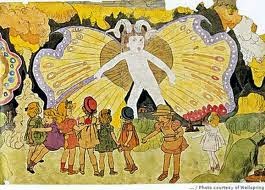
IN THE LAND OF HENRY DARGER - CHICAGO
Henry Darger reminds us that art is not about selling a
painting to match the couch – it’s about keeping your spirit alive no matter
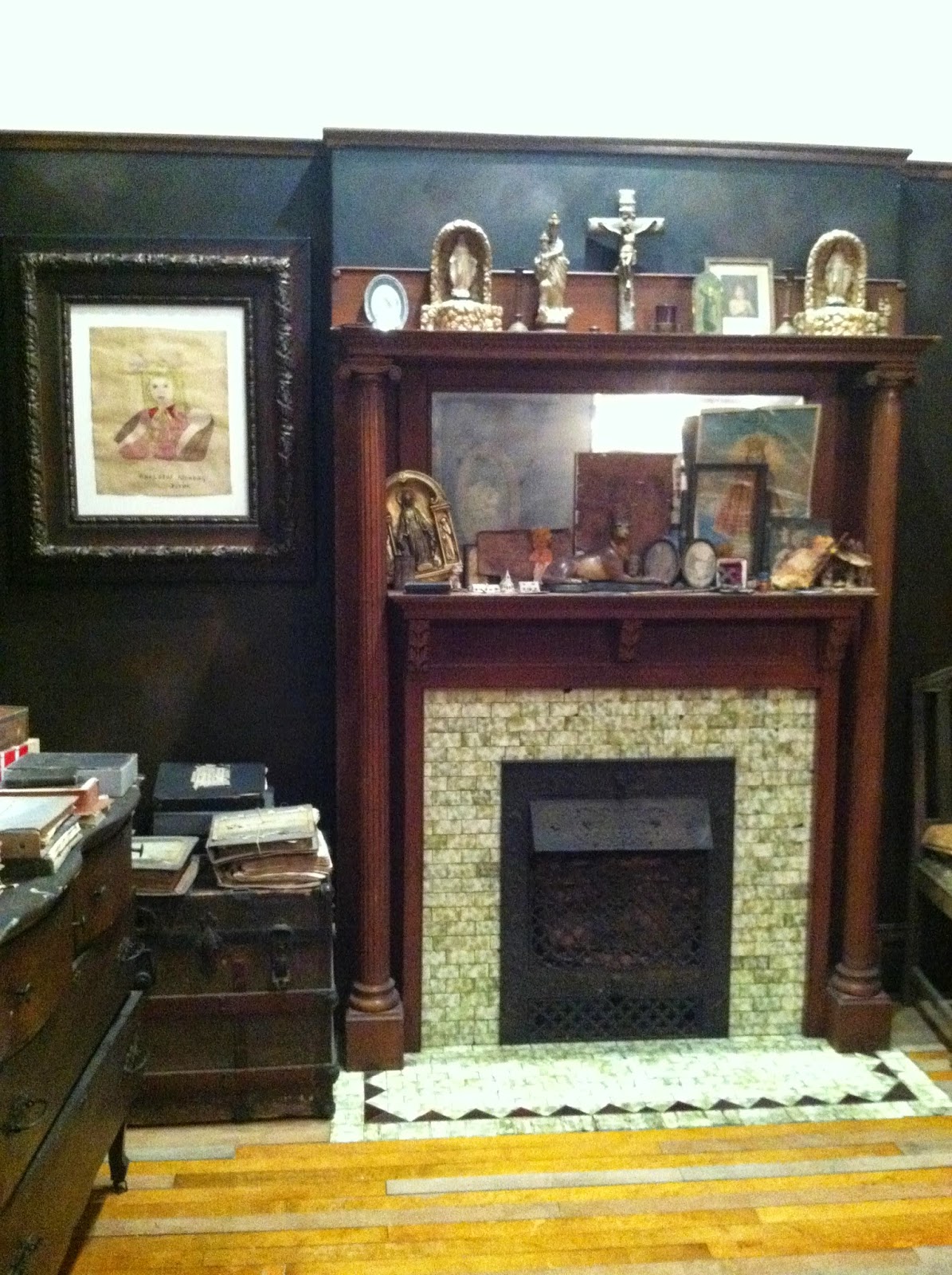
how harsh your circumstances. He’s
probably the greatest self-taught “outsider”
artist and the little room he retreated to at the end of his workday is perfectly
preserved in the Intuit Center for Intuitive and Outsider Art in Chicago at 756 N. Milwaukee Avenue.
I
am visiting Chicago this week so I have some time to catch up on Darger’s
story. Born in 1892, his mother died when he was four and his crippled and
impoverished father was taken to live in a Catholic Mission home. Soon after, Darger
was institutionalized in the Illinois Asylum for
Feeble-Minded Children. "Little Henry's heart was not in the right place."
He suffered from Tourette’s Syndrome, probable sexual abuse, forced labor and
severe punishments. He finally escaped at the age of 16 and returned to
Chicago. With the help of his godmother, he found menial employment in a
Catholic hospital where he worked and supported himself until his retirement in
1963. Except for a brief stint in the U.S.
Army during World
War I,
his life followed a rigid pattern: he attended daily Mass, frequently
returning for as many as five services; he collected and saved a bewildering
array of trash from the streets. His dress was shabby, although he attempted to
keep his clothes clean and mended. He was largely solitary; his one close friend,
William Schloeder, was like minded on the subject of protecting abused and
neglected children, and the pair proposed founding a "Children's
Protective Society", which would put such children up for adoption to
loving families. Schloeder left Chicago sometime in the mid-1930s, but he and
Darger stayed in touch through letters until Schloeder's death in 1959. In 1930,
Darger settled into a second-floor room on Chicago's North Side, at 851 W.
Webster Avenue. It was in this room, over the course of 43 years, that Darger produced
his breathtaking,
disturbing, monumental artwork and writings. His works including “In the Realms
of the Unreal” detail a complex fantasy world filled with idyllic beauty and
hellish violence.
Darger’s secret life’s work was found by his
landlord shortly after he moved out of his apartment and into a nursing home. Darger died in 1973 and is buried in All
Saints Cemetery in Des Plaines, Illinois, in a plot called
"The Old People of the Little Sisters of the Poor Plot". Darger's
headstone is inscribed "Artist" and "Protector of
Children". Darger once wrote of children's right "to play, to be
happy, and to dream, the right to normal sleep of the night's season, the right
to an education, that we may have an equality of opportunity for developing all
that are in us of mind and heart."
Subscribe to:
Posts (Atom)